
For global T1D collaboration, trust comes first.
In Uganda, thousands of children and young adults with type 1 diabetes (T1D) still struggle to access the care, supplies, and support they need to survive. Closing this gap requires not just building infrastructure and stocking insulin — it requires trust.
That was the thread running through ALIGN-T1D's recent event on the sidelines of the 79th World Health Assembly (WHA) in Geneva, where members of the global T1D community gathered to share how ALIGN-T1D is supporting countries to turn shared ambition into shared action.
Through a country-led model, ALIGN-T1D works with governments, communities, and stakeholders to develop and implement national strategies to improve access to T1D care, supplies, and support.
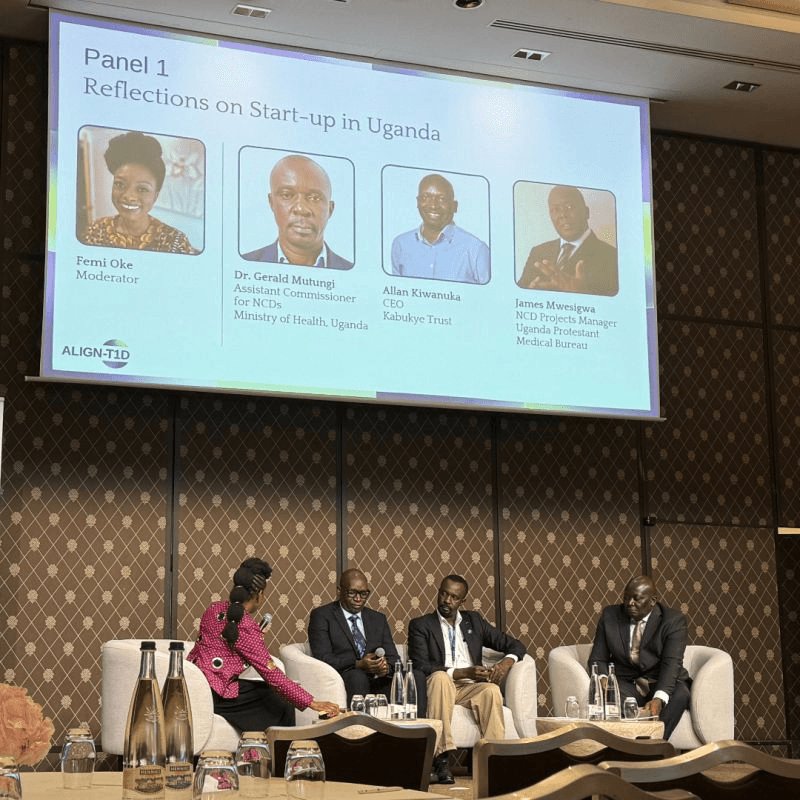
Uganda is the first country to put this model into practice. My organization, Kabukye Trust, a community-based advocacy group, has supported the Ministry of Health in convening partners across Uganda's T1D community. At the WHA event, I spoke about what I have seen firsthand: that trust between partners is the foundation for driving progress.
Creating the conditions for national collaboration
In Uganda, an estimated 30,000 people would still be alive today if they had not died early due to complications from T1D. Some of these people were never diagnosed; others were, but had limited access to care. As Dr. Gerald Mutungi, Assistant Commissioner for Noncommunicable Diseases at the Uganda Ministry of Health, reminded us at the WHA event: "These are not just statistics. These are children. These are lives being lost."
ALIGN-T1D exists because no single organization or initiative can close that gap alone. The model helps countries bring partners together to build one plan and act on it. In Uganda, that meant bringing seventeen organizations to the table under the leadership of the Ministry of Health.
But putting seventeen organizations in a room did not mean that we all trusted each other immediately. Trust was built over time, through showing up consistently, being transparent about what was and was not working, and sharing resources equitably.
James Mwesigwa of the Uganda Protestant Medical Bureau, an ALIGN-T1D Uganda partner, described a few key principles that helped anchor our partnership. Early on, we agreed that the ministry had to lead; simpler is better when lives are at stake; and no matter how big or small the partner, everyone must be willing to work and win together. Those principles created the space for partners to speak openly so that we could problem-solve together rather than around each other.
Recently, we've been putting our trust to the test as we work through shared financial planning. It has been emotionally, politically, and diplomatically daunting — but it is also a clear sign that without trust, none of this is possible.
One takeaway for any country starting this process: before you work on strategy, work on the conditions for trust.
Aligning global partners behind country strategies
ALIGN-T1D's model was created to address a prevalent challenge across the global T1D community: committed organizations are doing good work, but often duplicating efforts and failing to address the greatest needs.
In Geneva, it occurred to me that launching ALIGN-T1D required the same trust-building effort at the global level as it did on the ground in Uganda.
"Having a shared vision around [ALIGN-T1D's] impact is the first challenge. Then you need to build a community around that vision," said Raoul Bermejo of UNICEF, which is part of ALIGN-T1D's Strategic Advisory Group.
Jon Fairest, head of Sanofi's Global Health Unit, an ALIGN-T1D partner, said that clarity on shared goals and shared roles also promoted collaboration, as did a willingness to prioritize expertise over ego.
But he was equally direct about what has been missing in many global efforts to advance T1D outcomes: the participation of ministries of finance. Until they are included, sustainable funding for noncommunicable diseases (NCD) like T1D will remain, in Jon's words, an aspiration.
ALIGN-T1D's role is to help countries get to that point — where T1D and broader NCD care, supplies, and support are no longer dependent on short-term assistance but permanent parts of a country's health budget and fully integrated into national health systems.
As in Uganda, global partners are still learning to trust each other. This challenge is part of the ALIGN-T1D Secretariat's charge as the model grows into its Scale-Up phase.
Operating from lived expertise
None of this work can be effective, however, without the trust and leadership of people living with and affected by T1D.
In Geneva, Nupur Lalvani, founder of the Blue Circle Diabetes Foundation in India and a community representative on ALIGN-T1D's Strategy Steering Group, described a pattern many of us recognized: institutions gestured towards lived experience, sprinkling it on their work "like a garnish," instead of soliciting real input.
ALIGN-T1D is breaking that pattern. The Strategic Steering and Strategy Advisory Groups have included global representatives of the T1D community since inception. And as countries have begun developing national strategic plans, ministries of health and coordinating partners have engaged people living with T1D to ensure those plans reflect the priorities and lived expertise of the communities they are meant to serve.
In Uganda, T1D advocates like Edith Mukantwari have been invaluable to refining our national approach. They have kept us honest and focused on the most critical needs.
"Nothing for us, without us. We cannot pretend to be for them without them," as Dr. Mutungi shared.
The work ahead
Yes, ALIGN-T1D is still in the early phases of establishing national plans across all Start-Up countries, and the challenges ahead are not insignificant — supply chains need strengthening, healthcare providers need training, systems need integrating and sustaining.
If the event in Geneva clarified one thing, it is that trust is not just a precursor for this work. It is the work. As more countries join ALIGN-T1D's Scale-Up phase, we will need to continue building the trust that allows us to move from shared ambition to shared action.
Because changing the future of T1D care takes all of us.
This article was first published by ALIGN-T1D.